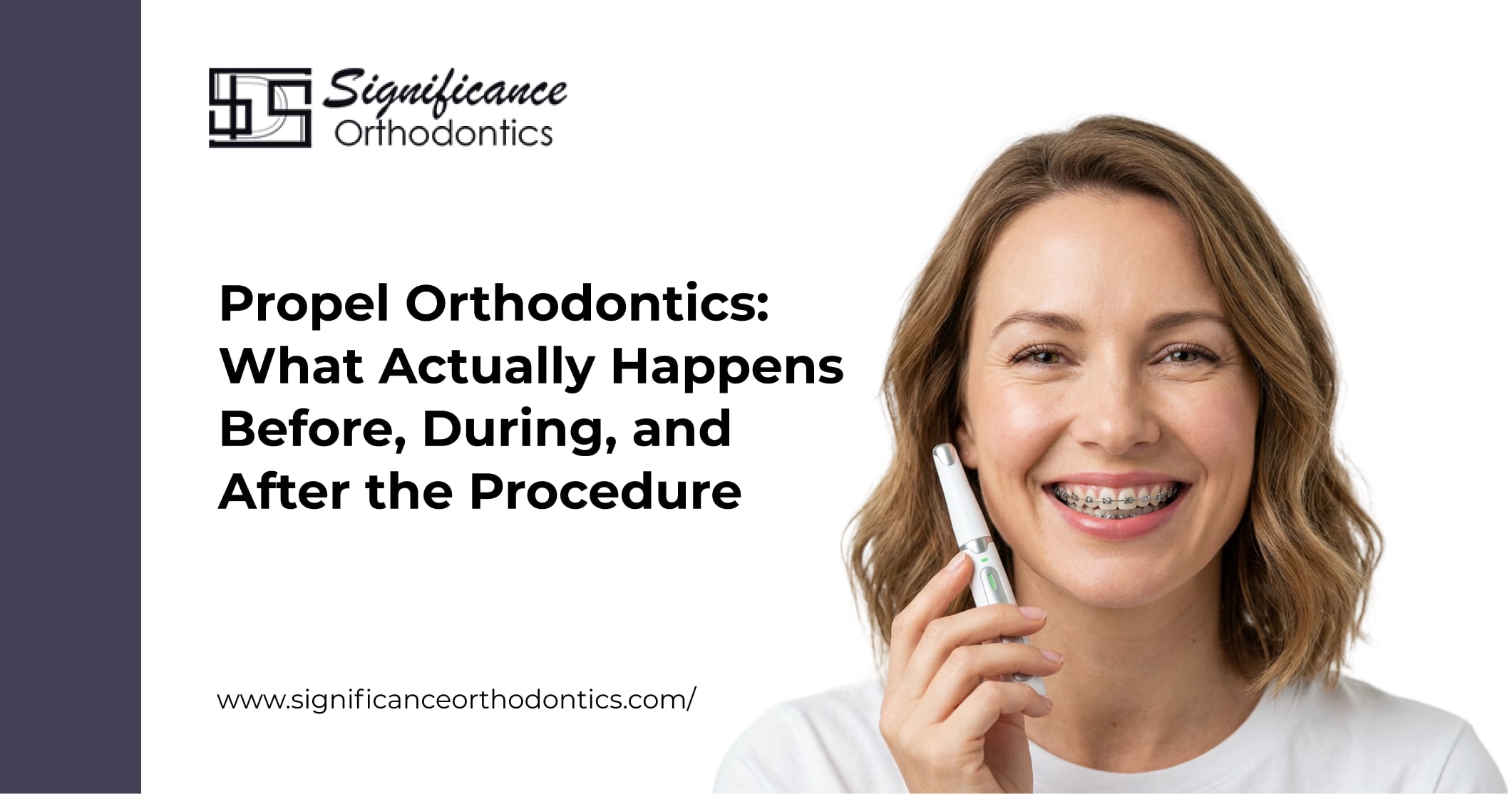
Propel orthodontics includes two distinct technologies — an in-office micro-perforation procedure and an at-home vibration device — and patients frequently confuse the two. Knowing which one you’re receiving, how each works biologically, and what to do (and not take) afterward is the difference between accelerated results and wasted effort.
Propel MOPs vs. Propel VPro: Two Very Different Procedures
This is where most patients get lost. The brand name “Propel” covers two entirely separate technologies, and the experience of each couldn’t be more different.
Propel MOPs (Micro-Osteoperforations) is an in-office clinical procedure. Your orthodontist applies a local anesthetic to the treatment area, then uses a specialized device to create small, precise perforations in the alveolar bone between targeted teeth. The procedure typically takes 15 to 20 minutes. There is a numbing injection. There is minor pressure during the perforations. And yes — there is a brief recovery window afterward, which we’ll cover in detail below.
The biology behind MOPs is well-established. Research published in PMC confirms that micro-osteoperforations trigger the regional acceleratory phenomenon (RAP), a controlled inflammatory response that recruits osteoclasts, increases bone turnover, and accelerates tooth movement through the surrounding jaw structure. The perforations are intentionally creating localized trauma to stimulate the body’s healing response — faster bone remodeling means faster tooth movement.
Propel VPro, by contrast, is a completely non-invasive, at-home device. It’s a vibrating mouthpiece used for five minutes per day, typically while wearing aligners. No numbing. No in-office visit required for daily use. No perforations. The mechanism is different — high-frequency vibration stimulates the periodontal ligament and surrounding bone cells to enhance remodeling — but the invasiveness level is nowhere close to MOPs.
When a patient asks “what’s the downtime after Propel?” — the answer depends entirely on which Propel they’re discussing. VPro has essentially zero downtime. MOPs has a real, manageable recovery period that deserves honest explanation. If you’re also exploring braces and Invisalign in Las Vegas, understanding how acceleration technologies pair with each treatment type is an important part of the conversation.
Why You Cannot Take Ibuprofen After a MOPs Procedure
This is the most overlooked — and most consequential — post-procedure instruction patients receive.
After micro-osteoperforations, the treatment area will feel sore. That soreness is not a side effect to suppress. It is the procedure working. The entire mechanism of MOPs relies on a localized inflammatory cascade: cytokines like TNF-alpha and IL-1 are released, osteoclasts are recruited, and bone remodeling accelerates. According to Mayo Clinic, ibuprofen and other NSAIDs work by inhibiting the production of prostaglandins — the same inflammatory mediators that drive this biological process.
In plain terms: taking Advil, Aleve, or any NSAID after MOPs chemically shuts down the inflammation your orthodontist just intentionally triggered. You’ve paid for a procedure that the painkiller actively reverses.
The only approved pain management after Propel MOPs is acetaminophen (Tylenol). Acetaminophen addresses pain centrally without blocking the peripheral inflammatory pathway. It manages discomfort without interfering with bone remodeling activity.
This NSAID restriction typically applies for the first 48 to 72 hours post-procedure, though your orthodontist will provide specific guidance based on your case. If you take prescription NSAIDs for an unrelated condition, raise this with your provider before scheduling MOPs — it’s a genuine clinical consideration, not a minor footnote.
The First 48 Hours: What Recovery From MOPs Actually Looks Like
“Zero downtime” is technically true in the sense that most patients return to work or school the same day. It is misleading in the sense that your mouth has just had multiple micro-perforations made through soft tissue into bone — and those sites need deliberate care.
Eating in the first 48 hours: Soft, room-temperature foods are strongly preferred. Avoid spicy foods entirely — capsaicin creates intense stinging at perforation sites. Avoid highly acidic foods like citrus and vinegar-based dressings. Avoid anything with small seeds (sesame, chia, poppy) that can lodge in the micro-openings and introduce bacteria. Think yogurt, eggs, soft pasta, and mashed vegetables — nothing that requires aggressive chewing near the treated areas. The same caution applies broadly to braces and dental health in Las Vegas, where diet choices during treatment can significantly affect outcomes.
Oral hygiene modifications: Do not use an electric toothbrush directly on treated areas for at least 48 hours. The vibration and pressure can disturb the micro-wound sites. Use a soft-bristle manual brush with gentle strokes. Replace alcohol-based mouthwashes with warm salt water rinses or a prescribed chlorhexidine rinse — alcohol-based products cause stinging and can slow soft tissue healing. Rinse gently; don’t swish aggressively.
What to watch for: Mild swelling and tenderness in the first 24 to 48 hours is normal and expected. Cleveland Clinic notes that maintaining consistent oral hygiene after dental procedures significantly reduces infection risk. If you notice increasing swelling after 72 hours, discharge, or fever, contact your orthodontist promptly.
The recovery is genuinely manageable. Most patients describe it as comparable to the soreness after a wire adjustment — concentrated in one area, and resolving within a few days.
What the Research Says About Accelerated Orthodontics Overall
MOPs and VPro don’t exist in isolation. They’re part of a broader, well-researched category of accelerated orthodontics that has been studied for decades. A narrative review in PMC found that various acceleration techniques — surgical and non-surgical — have demonstrated the capacity to reduce treatment times by up to 70% in controlled settings. The mechanisms differ, but the underlying goal is consistent: modify the biological environment around the tooth to allow faster, safer movement.
Denpedia’s overview of orthodontic treatment reinforces that longer treatment durations carry real risks — including enamel decalcification, root resorption, and increased susceptibility to gum disease. Shortening treatment time isn’t just about convenience; it reduces cumulative exposure to those risks.
For adult patients especially, accelerated options matter more. Adults have lower baseline bone metabolic rates than adolescents, meaning conventional treatment naturally takes longer. MOPs directly addresses this by pharmacologically bypassing the rate-limiting step — osteoclastic activity — rather than waiting for the body to respond at its own pace. Patients considering adult braces in Las Vegas are often the strongest candidates for acceleration technologies precisely because of this biological difference.
At Significance Orthodontics, candidacy for MOPs or VPro depends on the specifics of your case, your treatment timeline, and your orthodontic goals. Neither technology is a universal add-on — both are clinical decisions made in the context of a comprehensive treatment plan. You can review before and after photos from actual patients to better understand the range of outcomes achievable with accelerated orthodontic approaches.
Schedule a Consultation at Significance Orthodontics in Las Vegas
If you’re weighing accelerated orthodontic options — whether that’s in-office micro-osteoperforations or the at-home VPro device — the starting point is a conversation with an orthodontist who can evaluate your specific case. For patients who want to understand the full scope of what’s possible, braces Vegas: everything you need to know is a helpful resource to review before your appointment.
Significance Orthodontics serves patients throughout the Las Vegas Valley, including Summerlin, Henderson, and North Las Vegas. Schedule a new patient exam to discuss whether Propel is the right fit for your treatment plan.
Medical disclaimer: This article is for informational purposes only and does not constitute medical or dental advice. Always consult a licensed orthodontist or dental professional regarding your individual treatment options, recovery protocols, and medication use.