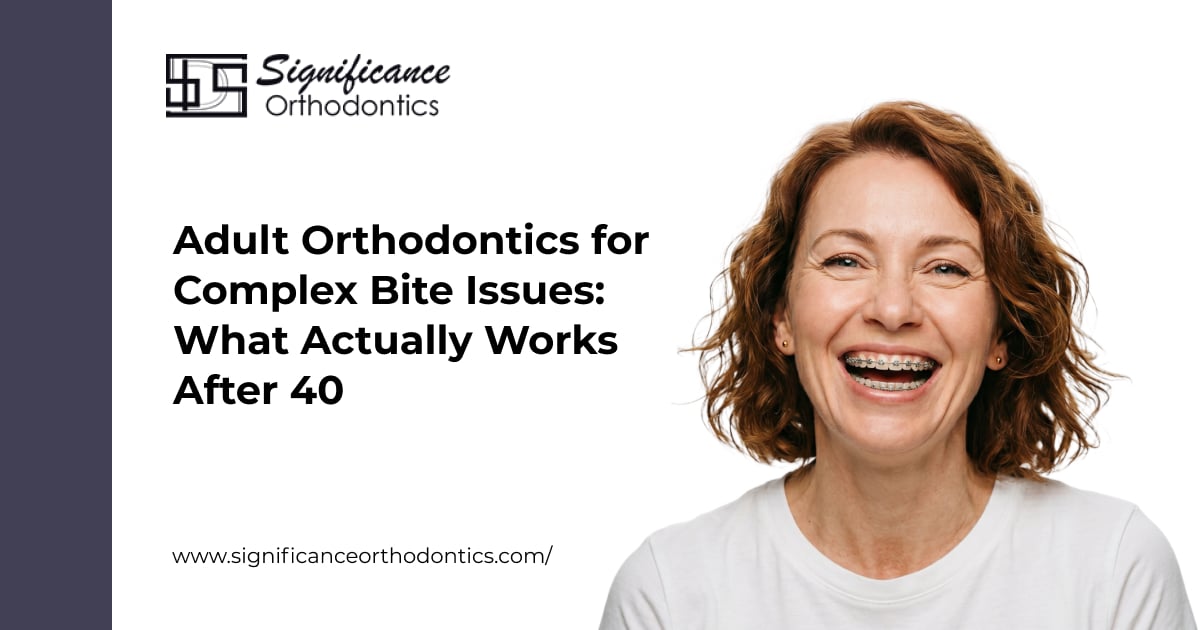
Adult orthodontics can effectively treat overbites, underbites, open bites, and deep bites — even in fully developed jawbones. The key difference from teen treatment is that complex adult cases often require advanced tools like TADs, a periodontal pre-clearance process, and sometimes a restorative “Phase 2” to complete the result.
TADs Changed Everything for Adults Who Were Told They Needed Surgery
For years, I watched adults come into consultations having already been told the same thing: “Your bite is too complex for braces alone. You’ll need jaw surgery.” Many of them walked away without any treatment at all. That gap bothered me. For Las Vegas-area patients, modern technology has significantly expanded what is possible without surgery.
The real issue isn’t complexity — it’s anchorage. In a growing teenager, the jawbone is actively remodeling, which gives orthodontists biological leverage. In an adult, that leverage disappears. To move teeth in three dimensions without a growing jaw to assist, you need a fixed point of force that doesn’t shift. That’s exactly what temporary anchorage devices (TADs) provide.
TADs are small titanium mini-screws placed temporarily into the jawbone. They don’t integrate permanently — they’re removed once treatment is complete. But while they’re in place, they give me a stable anchor to push or pull specific teeth in ways that standard brackets simply can’t achieve. For a severe overbite, I can use TADs to “intrude” the upper molars downward, which rotates the jaw closed without surgery. For a deep bite with overerupted incisors, the same principle applies. Research published in PMC confirms that TADs allow correction of skeletal bite discrepancies that previously required orthognathic surgery, with lower risk and faster recovery.
This positions TADs as a genuine middle ground — not braces-only, not surgery, but a precision hybrid that’s made complex adult treatment far more predictable. If you’re an adult considering orthodontic treatment, exploring braces for adults Las Vegas can help you understand what modern options are available for your specific case.
The Skeletal vs. Dental Distinction That Changes Your Treatment Plan
When patients ask me, “Can you fix my overbite?” the first question I ask back is: where is the problem actually coming from?
A dental overbite means your teeth are tilted in a way that creates the overlap. A skeletal overbite means the underlying jawbone relationship is off. In adults, these require completely different strategies.
For dental bite problems, moving teeth is often sufficient. For skeletal discrepancies in adults — where the bone has fully fused and won’t respond to growth modification — I use what’s called camouflage orthodontics. Rather than moving the jaw itself, I tilt the teeth strategically so the upper and lower arches meet properly. The jaw relationship doesn’t change, but the bite functions correctly and the smile looks balanced.
Camouflage works brilliantly for mild to moderate skeletal discrepancies. The trade-off is real though: there are limits. If I tilt teeth too far to compensate for a significant skeletal jaw mismatch, it can flatten or protrude the lip profile in ways that compromise facial aesthetics. A WebMD overview on underbites notes that severe skeletal cases genuinely involve more complex treatment — and that distinction matters when setting expectations.
For Class III skeletal underbites specifically, nonsurgical camouflage using metal braces in Las Vegas NV and skeletal anchorage can achieve stable results in borderline cases. For true severe skeletal discrepancies, surgery remains the most predictable path. Part of my job is helping each patient understand clearly which category they’re in.
Why Adult Bite Correction Requires a Periodontal “Pre-Flight Check”
Moving teeth through adult bone is fundamentally different from moving them through a teenager’s. Adult bone is denser, and many adults — especially those over 40 — present with some degree of periodontal bone loss, gum recession, or reduced bone volume around certain teeth.
This matters enormously for complex bite moves. When I’m intruding teeth to correct a deep bite, or retracting a whole arch to fix an underbite, the tooth is traveling a significant distance through bone. If the surrounding bone is thin or compromised, that movement can cause recession or root resorption. According to PMC research on adult orthodontic patients over 40, periodontal bone loss and incisor irregularity are closely linked in this population — which means the two conditions need to be treated in coordination.
Before I begin any complex adult bite correction, I require a full periodontal evaluation and, in many cases, a CBCT (cone-beam CT) scan to assess bone volume in three dimensions. If bone is thin in the path of tooth movement, I’ll refer the patient for a bone or gum graft first. This isn’t a delay — it’s what makes the orthodontic result stable long-term. Understanding why Significance Orthodontics takes this comprehensive approach can give you confidence in the level of care you’ll receive.
Braces Alone May Be “Phase 1” — Here’s What Phase 2 Looks Like
This is the part most orthodontic content skips entirely, and I think it does patients a disservice.
Adults with long-standing bite problems — deep bites, severe overbites, crossbites — have often spent 10, 20, or 30 years grinding their teeth in a misaligned position. Even after I move the roots into perfect alignment, the edges of the teeth are frequently worn down unevenly. The roots are straight; the crowns look short, chipped, or asymmetrical.
Orthodontics is Phase 1: getting the teeth into the right position. For patients who prefer a more discreet treatment path, Invisalign in Las Vegas offers a clear aligner option that can address many complex bite issues while remaining virtually invisible. Phase 2 is often cosmetic bonding or porcelain restorations to rebuild the tooth height lost to years of attrition. Without Phase 2, patients sometimes feel their smile still looks “off” even though the bite is clinically correct. That’s not a treatment failure — it’s an incomplete treatment plan.
A Healthline overview on deep bites confirms that deep bite correction is a multi-step process, and research on adult orthodontic outcomes in PMC emphasizes that satisfaction depends heavily on managing patient expectations from the start.
I walk every complex adult patient through both phases during their consultation so there are no surprises. The goal isn’t just a corrected bite on an X-ray — it’s a result that looks and functions the way you expect. For adults who want a less noticeable treatment option during this process, clear braces in Las Vegas can provide effective bite correction with a more aesthetic appearance.
Ready to Talk About Your Bite in Las Vegas?
Complex bite issues are treatable at any age. If you’ve been told you’re “too old” or that surgery is your only option, I’d genuinely encourage a second opinion.
At Significance Orthodontics, we work with adults across Las Vegas — including Summerlin, Henderson, and North Las Vegas — who are ready to address bite problems they’ve carried for years. Schedule a new patient exam and we’ll map out exactly what’s possible for your specific case.
Medical disclaimer: This article is for informational purposes only and does not constitute medical advice. Individual treatment needs vary. Consult a licensed orthodontist to discuss your specific condition and treatment options.