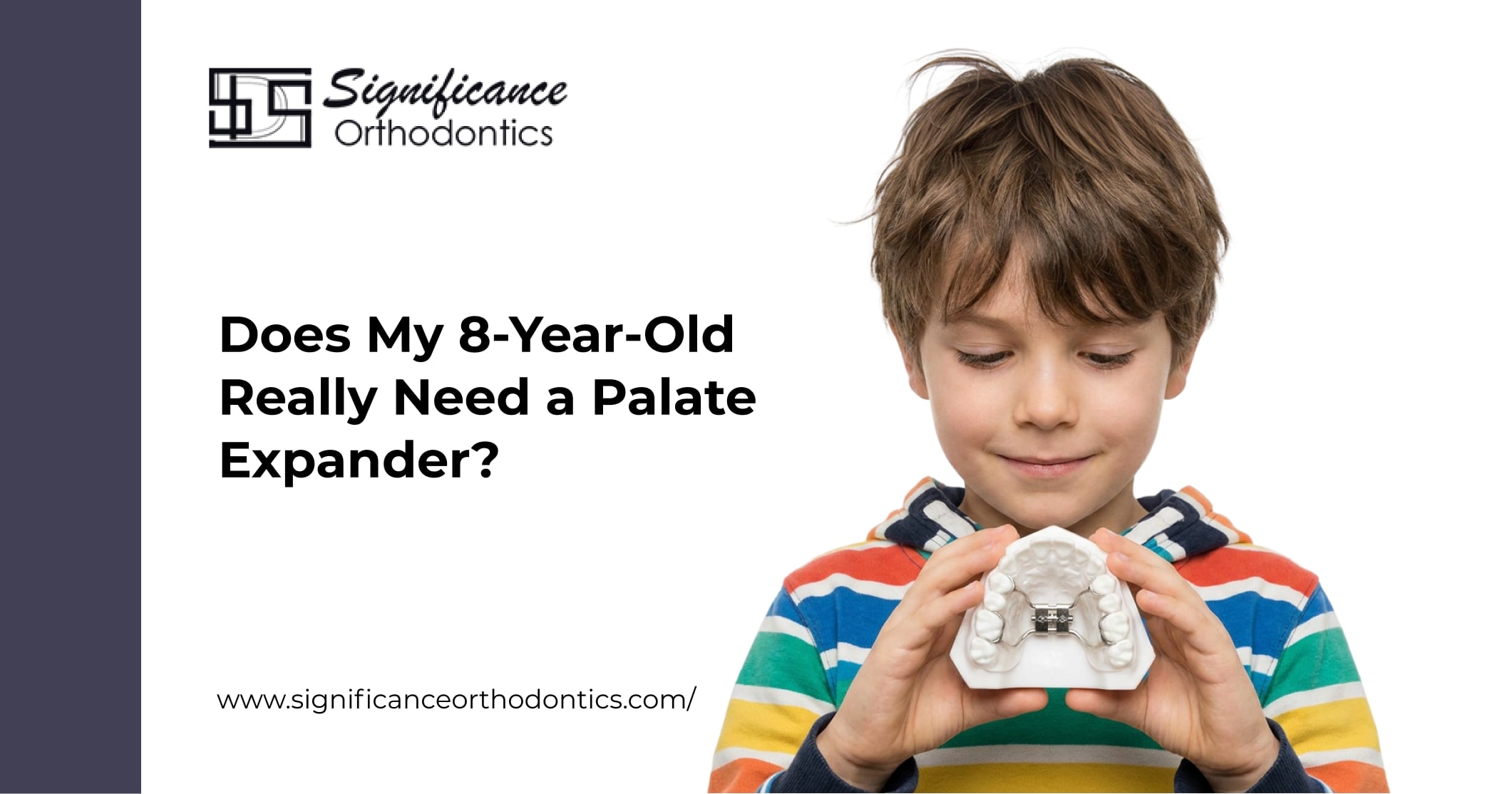
Palate expanders are sometimes genuinely necessary at age 8 — not just cosmetically, but to prevent permanent jaw asymmetry or airway problems. Whether your child actually needs one depends on the specific clinical finding, not just how crowded their teeth look.
When an Expander Isn’t Optional: Crossbites vs. Crowding
This is the question most Las Vegas parents never think to ask: is this expander truly necessary right now, or can we wait? The honest answer depends entirely on what the orthodontist is treating. Understanding braces and dental health in Las Vegas can help parents recognize why early orthodontic intervention sometimes matters beyond just straight teeth.
There are two very different scenarios where expanders get recommended at age 8. The first is a skeletal crossbite with a mandibular shift. This is when the upper jaw is narrow enough that the lower jaw physically slides to one side to find a comfortable bite. Left untreated, that repeated shift can cause permanent facial asymmetry — the lower jaw actually remodels itself into a crooked position over time. In this case, early expansion isn’t aggressive treatment. It’s prevention.
The second scenario is mild-to-moderate dental crowding with no jaw shift. Here, the teeth look a little bunched, but the jaw relationship is fine. For many of these children, a single phase of comprehensive braces around age 12 — once most permanent teeth have erupted — produces excellent results without Phase 1 intervention. No expander needed.
As Cleveland Clinic explains, palate expanders work by gradually moving both halves of the jawbone apart, which is most effective while those bones are still forming. That biological window is real. But it applies most critically to skeletal problems — not every case of crowding. A thorough orthodontic evaluation, which according to Cleveland Clinic’s orthodontics overview should happen no later than age 7, helps identify which category your child falls into. AAPD | Children’s Health Data tracks pediatric oral health trends that underscore why timely evaluation matters for long-term outcomes.
The Airway Connection Most Parents Don’t Hear About
Here’s something competing articles routinely leave out: a growing number of expanders are being recommended not primarily for tooth alignment, but for airway reasons.
The roof of the mouth and the floor of the nasal cavity share the same bone. When the palate is narrow and high-arched, the nasal cavity above it is correspondingly compressed. Widening the maxilla with an expander physically lowers and broadens the nasal floor, reducing upper airway resistance. This is why pediatricians and ENTs are increasingly coordinating with orthodontists when a child presents with chronic mouth breathing, enlarged adenoids, or signs of sleep-disordered breathing.
A child’s teeth might look relatively straight, yet an orthodontist may still recommend expansion because the jaw shape is contributing to a compromised airway. This isn’t a trend toward overtreatment — it reflects a genuine shift toward airway-centric orthodontic thinking. A Healthline overview of palate expanders notes that expanding the palate can help children who have obstructive sleep apnea, reinforcing this medical dimension of the treatment.
If your child snores, breathes through their mouth consistently, or has been evaluated by an ENT for sleep issues, mention that to your orthodontist. The conversation about expansion may take on a very different meaning. Parents considering braces for teens should also factor in whether early palate intervention could simplify later treatment.
Biological Age Matters More Than Chronological Age
Most articles say something vague like “expanders work best before puberty.” That’s technically true but incomplete. What actually determines success is the fusion stage of the midpalatal suture — the seam running down the center of the upper jaw where the two palatal bones meet.
In early childhood, this suture is largely cartilage. Through adolescence, it gradually interdigitates — the bone edges grow finger-like projections that interlock — and eventually fuses into solid bone in adulthood. The clinical problem is that this fusion doesn’t happen on a fixed calendar. Two 13-year-olds can have dramatically different suture maturity.
This is why experienced orthodontists use tools like CBCT imaging or Cervical Vertebral Maturation (CVM) staging — assessed from a lateral cephalometric X-ray — to evaluate biological rather than chronological age. The findings determine which approach is appropriate:
- Standard tooth-borne RPE — effective when the suture is open and unfused
- MARPE (Micro-implant Assisted Rapid Palatal Expander) — used for older teens where the suture is partially fused and tooth-borne forces alone would tip teeth rather than move bone
- SARPE (Surgically Assisted Rapid Palatal Expansion) — reserved for skeletally mature adults with fully fused sutures
Cleveland Clinic notes that because teens’ and adults’ bones are already strong and developed, expansion can take up to a year — and sometimes surgical assistance is required. Knowing where your child falls on that biological spectrum changes the recommendation entirely. For families weighing all their options, considering metal braces in Las Vegas alongside expander therapy is a conversation worth having with your orthodontist.
Why So Many Kids Seem to Be Getting Expanders Now
It can feel like every child in Summerlin or Henderson is coming home with an expander. There are legitimate reasons for the increase. Awareness of airway-related issues has grown substantially. Early orthodontic screening at age 7 catches problems that previous generations simply never addressed. And modern expander designs are more comfortable and precise than earlier versions.
That said, the FDA has specifically flagged certain fixed palatal expanders — including anterior growth guidance and osseo-restoration appliances — as devices whose safety and effectiveness for treating sleep apnea, TMD, or jaw remodeling in adults have not been established. The ADA reported on this FDA announcement, encouraging both patients and providers to report adverse events through MedWatch. Standard orthodontic expanders used in children for crossbites and jaw development remain on solid clinical ground — but it reinforces why choosing a qualified orthodontist matters. You can review before and after photos to better understand the kinds of outcomes orthodontic treatment can achieve.
Talk to an Orthodontist in Las Vegas
If your child’s pediatrician or dentist has mentioned an expander, or you’ve noticed jaw shifting, mouth breathing, or crowding, a dedicated orthodontic evaluation will give you a clear picture. Significance Orthodontics serves families across Las Vegas, Summerlin, Henderson, and North Las Vegas with comprehensive evaluations designed to answer exactly this question: does your child actually need treatment now, or can you wait?
Medical disclaimer: This article is for informational purposes only and does not constitute medical or dental advice. Always consult a licensed orthodontist or dental professional for diagnosis and treatment recommendations specific to your child’s needs.