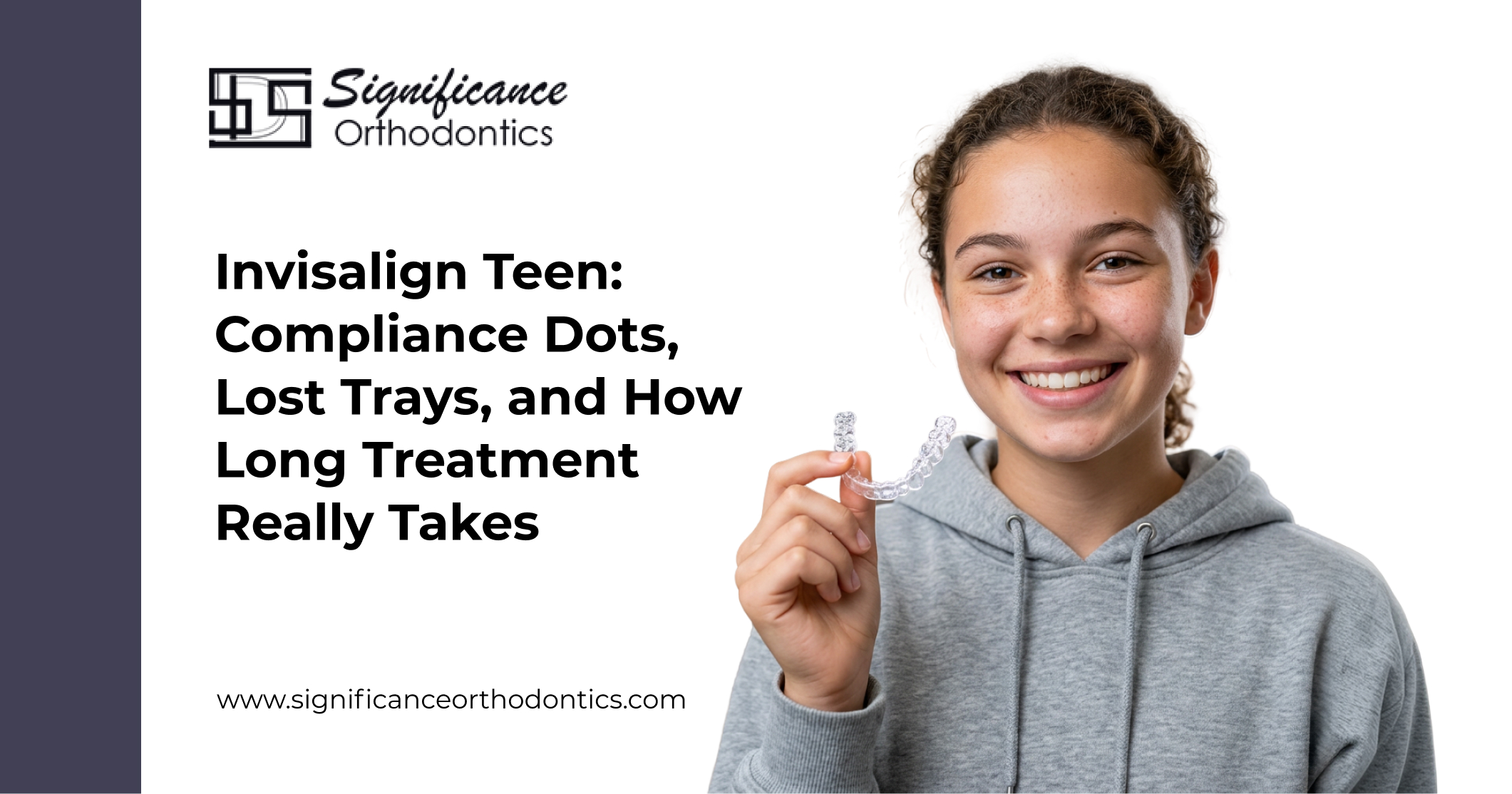
Invisalign Teen includes built-in compliance indicators and a replacement aligner policy designed specifically for teenagers. Treatment timelines differ from adults because growing jaws and unerupted teeth add biological variables that generic estimates ignore. Here’s what Las Vegas families need to know before starting treatment. Learn more about braces and Invisalign Las Vegas options available to your family.
The Blue Dot Science Parents Are Getting Wrong
Yes, Invisalign Teen trays include compliance indicators — but most explanations stop at “blue dots that fade.” The chemistry behind them matters, especially for parents wondering whether a teen could game the system.
Compliance indicators are small blue dots on the backs of the aligners that gradually fade through a combination of oral temperature, salivary enzymes, and the mechanical friction of the aligner seating against tooth enamel. That’s the key distinction: plain water soaking does not replicate those conditions. A tray left in a glass overnight won’t fade the same way a tray worn for 20–22 hours will. Orthodontists can spot the difference.
More importantly, compliance indicators are only one layer of clinical verification. When a teen hasn’t been wearing their trays consistently, teeth don’t track properly. Orthodontists check for “tracking gaps” — spaces between the aligner and the tooth surface — which reveal inconsistent wear regardless of what the indicator shows. The dots confirm good compliance; tracking gaps expose poor compliance even when dots have faded.
According to Healthline, wearing aligners for the full 20–22 hours daily is the single most important factor in treatment effectiveness. Skipping hours doesn’t just slow progress — it can require refinements that extend the entire treatment timeline.
What Happens When a Teen Loses an Aligner: A Clinical Decision Framework
Losing an aligner happens. The question isn’t whether to panic — it’s when in the wear cycle it happened, because that determines the next step.
Days 1–4 of a two-week set: The tray was doing its heaviest initial work. Teeth have not yet adapted to the new pressure. If the aligner is lost during this window, most orthodontists recommend stepping back to the previous tray temporarily. Moving forward too soon risks inadequate tooth movement and can create stress on tooth roots before bone remodeling has caught up.
Days 5–14 of a two-week set: Significant movement has already occurred. In this window, moving forward to the next tray — with an extended wear period — is typically more appropriate. Your orthodontist makes this call based on how your teen’s teeth are tracking.
The replacement policy matters here. Invisalign Teen is specifically designed with a replacement aligner clause — up to six free replacement aligners are included within the treatment contract, acknowledging that teenagers lose things. This is a meaningful structural difference from standard Invisalign, which does not include the same provision.
The practical takeaway: contact your orthodontist the same day an aligner is lost. Do not guess which direction to move. Provide the tray number and approximate wear day so the clinical team can make the right call quickly. Families exploring all their options can also review clear braces vs metal: which option is right for you to understand the full range of treatment choices.
Why Teen Timelines Are Biologically Different From Adult Timelines
Generic estimates of 12–18 months for Invisalign apply broadly, but teenage mouths introduce variables that can shorten or lengthen treatment in ways adult cases don’t encounter.
Eruption Tabs are engineered spaces built into teen aligners that hold room for teeth that haven’t fully erupted yet — most commonly second molars and upper canines. If those teeth are still emerging when treatment begins, the aligner series must account for them. This can extend the overall treatment arc, but it also means treatment can address spacing issues proactively rather than reactively.
Mandibular Advancement features address overbite correction during active growth spurts. In adolescents whose jaws are still developing, precision wings built into the aligners can guide jaw positioning in a way that simply isn’t possible once bone growth is complete. As WebMD notes, younger jawbones respond more readily to orthodontic pressure — a biological advantage that makes certain corrections faster and more stable in teens than in adults.
The American Dental Association’s Mouth Healthy resource confirms that treatment beginning while a child is still growing produces optimal results. That biological window is one reason starting treatment in adolescence — even if it feels early — often leads to more efficient outcomes. Parents considering braces for teens will find that starting early can also be beneficial in the long run.
A Healthline overview of Invisalign for overbite correction reinforces that treatment duration depends heavily on case complexity and patient age, with younger patients benefiting from active bone remodeling throughout the process.
For most teens, a realistic timeline falls between 12 and 24 months depending on case complexity, compliance, and whether growth-related features are part of the plan. Understanding braces and dental health in Las Vegas can help families set realistic expectations for the full treatment journey.
Schedule a Consultation at Significance Orthodontics in Las Vegas
If you’re weighing Invisalign Teen for your child — or wondering whether their case qualifies — the best next step is a clinical evaluation. Significance Orthodontics serves families throughout the Las Vegas Valley, including Summerlin, Henderson, and North Las Vegas. A consultation gives your teen a personalized timeline, a clear picture of what their treatment would involve, and answers to every question this article raised.
This article is intended for general informational purposes only and does not constitute clinical advice. Always consult a licensed orthodontist regarding your child’s specific treatment needs.