

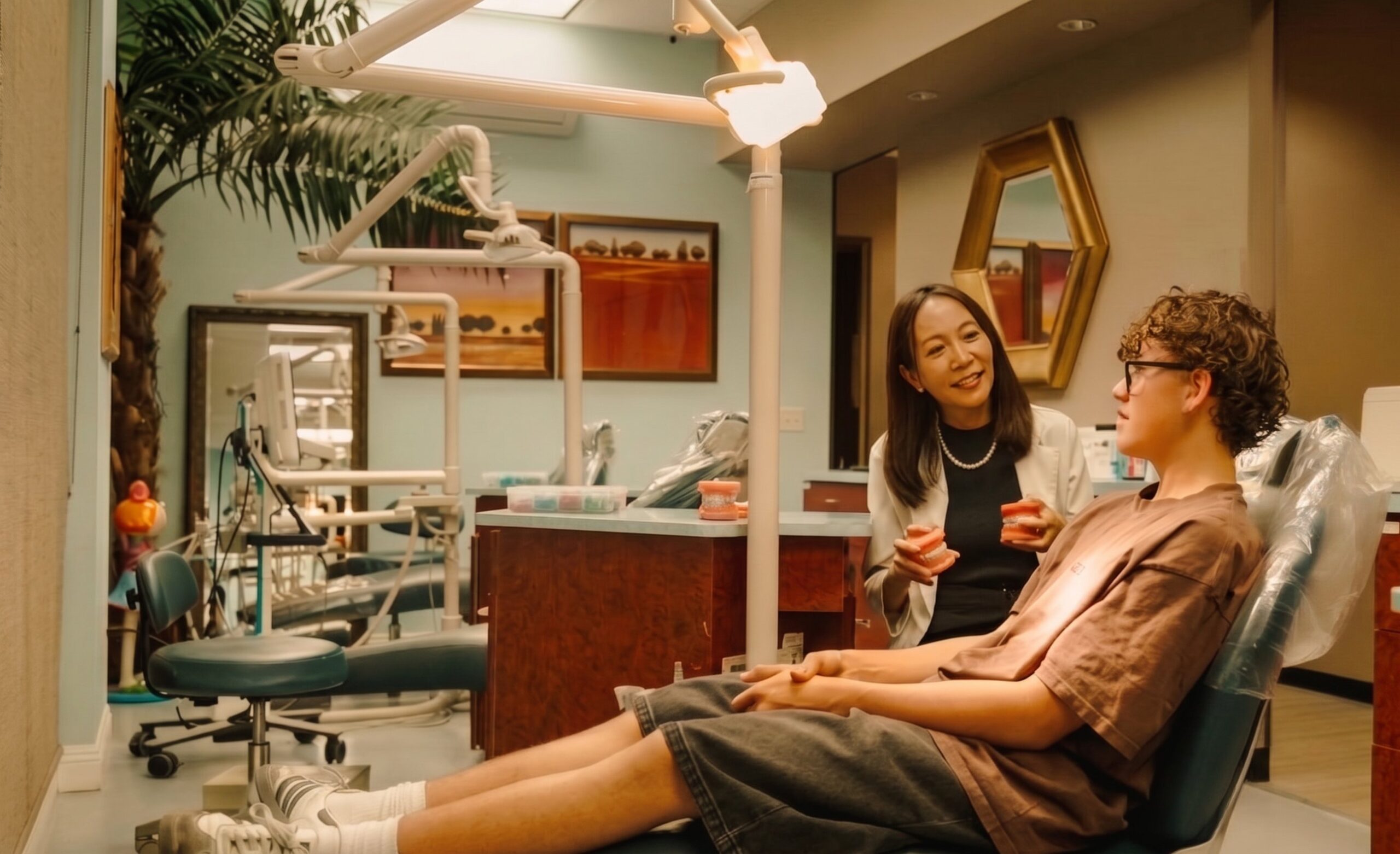
Came home from an adjustment with a little bag of tiny rubber bands? Those are elastics, and they have a real job to do. Here’s what they are, how to wear them, and what to do if you run out.
What do rubber bands on braces do?
Rubber bands, also called elastics, add extra force to move teeth in ways braces alone may not. According to the American Association of Orthodontists, they help with bite problems and stubborn misalignments. They hook onto small hooks on selected brackets, either between the upper and lower teeth or between teeth in the same jaw. Your orthodontist chooses where they go, based on the movement your teeth need.
Not everyone with braces wears them. If they’re part of your plan, Dr. Victoria explains why.
Source: American Association of Orthodontists, “Orthodontic Elastics: Are They For You?” (aaoinfo.org).
How do I wear my elastics?
Wear your elastics exactly as prescribed, and replace them with fresh ones every day or as often as your orthodontist tells you. Worn-out bands lose their stretch. The AAO’s other tips:
- Take them out to eat and to brush, then put in fresh ones.
- Wash your hands before you handle them.
- Keep spares with you, stored somewhere cool and dry, out of the sun.
- Don’t rinse and reuse them. Elastics are single-use.
Your first few days may feel sore. That’s normal, according to the AAO, and taking the bands out to ease it isn’t recommended.
Will wearing extra rubber bands speed up my treatment?
No. Doubling up won’t move teeth faster, and wearing more than prescribed can harm teeth and jaws or slow things down, the AAO says. Steady wear, as prescribed, is what keeps treatment on track.
How long does treatment take overall? Treatment typically takes 8 to 24 months, and your own timing depends on your treatment plan.
What if I run out of elastics?
Call your office right away rather than waiting for your next visit. That’s the AAO’s advice, and it’s the fastest way to stay on track.
Craig, in North Las Vegas: (702) 647-8114. Fort Apache, in Southwest Las Vegas: (702) 213-7460. Both offices are open Monday to Thursday 9 to 5, and Friday 8 to 2:30.
A different problem, like a loose bracket or a poking wire after hours? Here’s what to do after hours.
Can I wear elastics if I’m allergic to latex?
Tell us about a latex allergy. The AAO notes that elastics may contain latex, and that latex-free options may be available.
How do I keep my teeth clean with braces and elastics?
Take your elastics out to brush, then put in fresh ones, the AAO says. As for the brushing itself, in Dr. Victoria’s words: “Most people don’t realize how easy it is to clean your braces and teeth during orthodontic treatment.” Her rules: “The most important time to brush and floss is before you go to bed. You absolutely CAN NOT skip this one.” “There are two areas that are the most important to brush: along the junction of your gum and teeth, and also the area around the brackets.” “Nothing can replace flossing.”
Do repairs and adjustment visits cost extra?
Your treatment fee includes your records and x-rays, your adjustment visits, aligner refinements, repair visits, your first set of retainers and your checks after treatment. After the first visit or two, most visits last 10 to 30 minutes and are spaced 6 to 12 weeks apart.
More on what braces cost and how payment plans work.
Frequently asked questions
How often are visits during treatment?
After the first visit or two, most visits last 10 to 30 minutes and are spaced 6 to 12 weeks apart.
What does my treatment fee include?
Your treatment fee includes your records and x-rays, your adjustment visits, aligner refinements, repair visits, your first set of retainers and your checks after treatment. Our Treatment Coordinator goes over your costs with you, including replacement retainers, and gives you everything in writing before you start.
How do I keep my teeth clean with braces?
In Dr. Victoria’s words: “The most important time to brush and floss is before you go to bed. You absolutely CAN NOT skip this one.” “There are two areas that are the most important to brush: along the junction of your gum and teeth, and also the area around the brackets.” “Nothing can replace flossing.”